The Man Behind the Counter Knew More About Your House Than You Did — And He's Gone Now
The Man Behind the Counter Knew More About Your House Than You Did — And He's Gone Now
Walter ran the hardware store on Elm Street for thirty-one years. He knew where every single item in that store lived — not approximately, but precisely. He knew that the 5/16-inch hex bolts were on the third shelf of aisle four, left side, second bin from the top. He knew this the way you know your own phone number.
But more than that, Walter knew houses. He knew the quirks of the old craftsman bungalows on the north side of town and the particular plumbing problems that came with the postwar ranch houses near the school. You could walk in, describe a drip, and he'd hand you the right washer before you finished the sentence. Then he'd tell you how to install it.
That was the hardware store. And it's mostly gone.
What the Old Hardware Store Actually Was
The independent hardware store was never really just a retail operation. It was something closer to a neighborhood institution — part supply depot, part repair clinic, part informal school. The owner and his staff had usually spent years, sometimes decades, accumulating the kind of practical knowledge that can't be downloaded or searched.
In its prime, the American hardware store was a place where a first-time homeowner could walk in terrified and walk out confident. Where a retiree tinkering with a weekend project could get a second opinion from someone who'd seen every variation of that project go right and wrong. Where the answer to "do I need a permit for this?" was delivered with the casual authority of hard-won experience.
These stores were dense with inventory and light on square footage. They smelled like machine oil and sawdust. The bins of loose hardware — bolts, washers, cotter pins, wing nuts — were organized with a logic that only made sense once someone explained it to you, and then it made perfect sense forever.
They were, in a word, irreplaceable. And we replaced them anyway.
The Rise of the Orange and Blue Giants
Home Depot opened in 1978. Lowe's had been around since the late 1940s but transformed into its current warehouse format through the 1980s and 90s. By the time the model fully matured, the math for independent hardware stores got brutal.
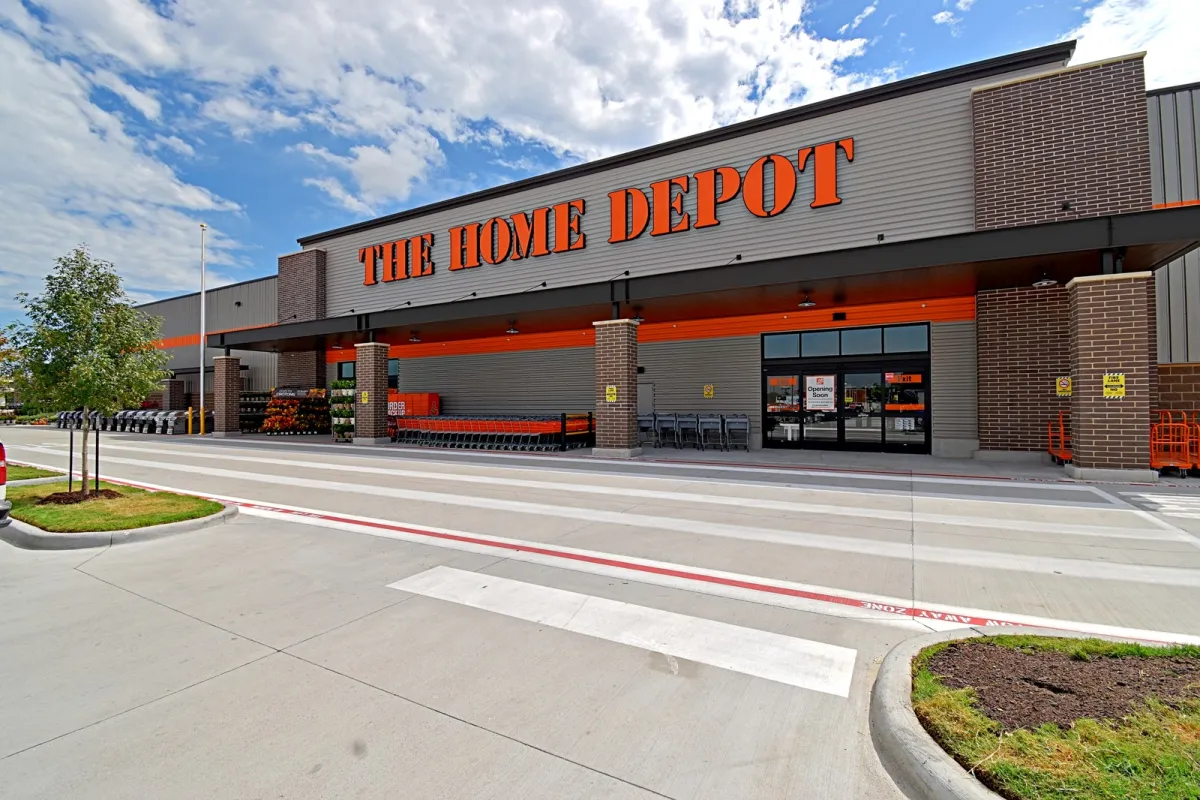 Photo: Home Depot, via d1xchyov513y0i.cloudfront.net
The big boxes could stock more, price lower, and absorb losses that would sink a family operation in a season. They built on the edges of towns, drew customers from a twenty-mile radius, and slowly drained the foot traffic that kept the Walters of the world in business. The National Hardware Association estimates that tens of thousands of independent hardware stores have closed since the big-box era began in earnest.
What replaced them is not without its virtues. The selection is genuinely staggering. The lumber yards are enormous. The tool rental programs are convenient. If you need seventeen specific things for a bathroom renovation, you can probably find sixteen and a half of them in one trip.
But what you cannot reliably find — and this is the thing that matters — is someone who knows what you're talking about.
The Education You Didn't Know You Were Getting
Here's what the old hardware store gave you that no warehouse chain can replicate: context.
When Walter handed you a washer and explained why your faucet was dripping, you didn't just leave with a part. You left with an understanding of how that faucet worked, why it failed, and what to watch for next time. That knowledge stacked. Over years of homeownership, those small tutorials added up to a working literacy about how your house functioned.
You learned that a squeaky floor usually meant a loose subfloor screw, not a structural crisis. You learned the difference between a load-bearing wall and a partition. You learned when to call a plumber and when the fix was a $2 part and twenty minutes of your Saturday afternoon.
That informal education made Americans more capable in their own homes. It built a quiet confidence in the idea that maintenance was something you could participate in, not just outsource. The house was yours to understand, not just to live in.
Now, the equivalent of asking Walter a question is typing symptoms into a YouTube search bar and watching a twelve-minute video filmed in someone's garage in Arizona that may or may not apply to your specific situation. The information exists. The relationship doesn't.
Something Else That Disappeared
Beyond the expertise, the independent hardware store was a community anchor in a way that's easy to underestimate until it's gone.
It was a place where you ran into your neighbors. Where the guy who'd lived on your street for forty years would overhear your description of a problem and tell you that the previous owner of your house had the same issue and here's what actually worked. Where local contractors stopped in every morning and the counter became an informal exchange for recommendations, warnings, and trade gossip.
That social infrastructure — the incidental knowledge-sharing that happened not because anyone planned it but because people kept showing up to the same place — was a genuine community resource. It helped new homeowners navigate unfamiliar territory. It kept local contractors honest, because their reputation lived in that store as surely as it lived anywhere.
No app has figured out how to replicate the guy who overhears your conversation and saves you a $400 service call.
What We Lost When We Stopped Asking
The disappearance of the neighborhood hardware store is part of a broader shift in how Americans relate to their homes. Home ownership used to come with an implicit expectation of basic competence — that you'd learn, over time, how to maintain the thing you'd bought. The hardware store was one of the systems that supported that expectation.
As those stores closed, the confidence eroded with them. A generation of homeowners grew up without a Walter to ask, and so they didn't ask. They called a contractor for things their parents would have handled on a Sunday afternoon. Not because they were lazy, but because the infrastructure that would have taught them — the store, the counter, the person behind it — wasn't there anymore.
Someone, somewhere, still knows how to fix a dripping faucet from a description alone. The trick is finding them before the water bill arrives.