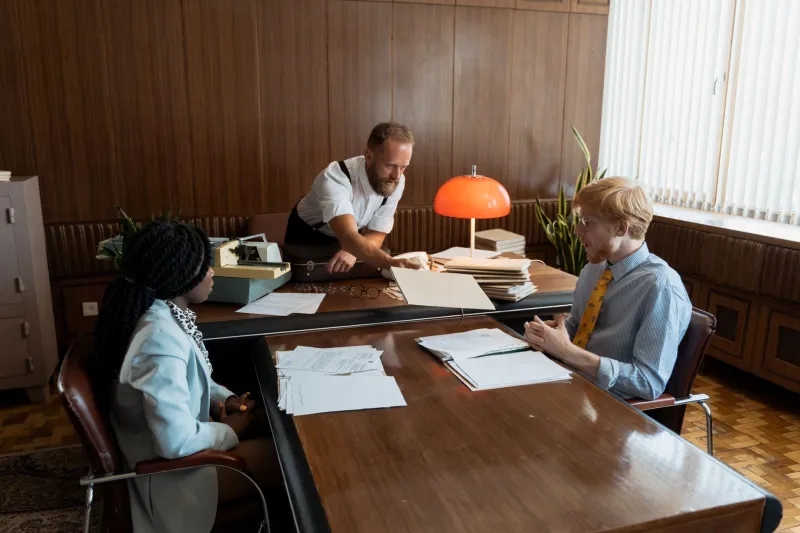
The Deal That Closed With a Handshake — And Neither Party Called a Lawyer

Picture a hardware store owner in 1962 agreeing to supply materials to a local contractor. They shake hands across the counter. The contractor knows the price, the owner knows when to expect payment, and neither one reaches for a contract because the relationship is the contract. The deal gets done. Both men go home satisfied.
That scene plays out differently now. Today, that same transaction might involve a purchase order, a supplier agreement, an indemnification clause, and a terms-and-conditions document that neither party will read in full. The hardware store might require the contractor to sign a credit application before the first order ships. The contractor's company might have a vendor onboarding process that takes three weeks.
The materials are the same. The people aren't so different. But the space between them has filled up with paper.
When Business Ran on Reputation
For much of American commercial history, reputation was the primary currency of business. In small towns and tight-knit industries, everyone knew who paid their debts and who didn't. A man's word — and it was mostly men in formal business settings, a separate and serious problem — carried genuine weight because breaking it had real consequences. You'd lose business. You'd lose standing. Word would get around.
This wasn't a naive system. It was a functional one, built on repeated interactions and community accountability. The local banker who extended credit to a farmer did so based on years of direct knowledge. The merchant who sold on account knew his customers personally. Trust wasn't assumed blindly — it was earned through track record and reinforced by social proximity.
Contracts existed, of course. Land sales, major loans, and formal partnerships were documented. But the threshold for when you needed a piece of paper was much higher, and the documents themselves were shorter, plainer, and written in language an ordinary person could actually follow.
How Litigation Changed the Language of Business
The shift didn't happen overnight. Through the latter half of the 20th century, a combination of forces gradually transformed the culture of American business agreements. Landmark lawsuits created new categories of corporate liability. Consumer protection legislation — well-intentioned and largely necessary — required disclosures that multiplied the paperwork attached to everyday transactions. The legal profession grew substantially, and with it, the expectation that any significant agreement should be reviewed by counsel.
By the time the internet arrived and digital commerce made it possible to enter agreements with a single click, the terms attached to those clicks had become extraordinary documents. Apple's iTunes terms of service, famously analyzed by a Norwegian blogger in 2011, took nine hours to read aloud. The average American encounters dozens of such agreements every year and reads virtually none of them.
We have built a legal architecture of almost incomprehensible scale around ordinary commercial life — and most of us navigate it by clicking "I Agree" without looking up.
The Hidden Tax on Small Business
For large corporations, legal complexity is a manageable cost. They have in-house counsel. They have compliance departments. They have systems.
For small business owners, the same complexity is a genuine burden. A 2022 report from the National Federation of Independent Business found that regulatory compliance — including contract-related obligations — was among the top concerns for small and mid-sized American businesses. Many small operators describe spending more time on paperwork and legal review than they did a generation ago, often for transactions that haven't fundamentally changed in nature.
The contractor who just wants to hire a subcontractor now needs a subcontractor agreement. The freelancer who lands a client needs an engagement letter, a scope-of-work document, and possibly a non-disclosure agreement before the first invoice. The food truck owner who wants to park in a private lot needs a licensing agreement reviewed by someone who went to law school.
None of these documents are necessarily unnecessary. But their cumulative weight falls hardest on the people who can least afford the time and money to manage them.
Trust Didn't Disappear — It Got Lawyered
Here's the uncomfortable irony at the center of all this: the explosion of contractual complexity hasn't necessarily made business more honest. Fraud, breach of contract, and commercial disputes are as common as they've ever been — arguably more so, given the scale of modern commerce. All those pages of fine print haven't eliminated bad actors. They've just created a more elaborate battlefield for fighting them.
What the paperwork has done is shift the locus of trust. We no longer trust the person across the table — we trust the document between us. And when the document fails, we trust the court. The relationship has been replaced by a system, and the system, whatever its virtues, doesn't know your name.
There's something genuinely lost in that transition. The handshake deal wasn't just simpler — it was human. It required both parties to show up as people, not just as signatories. It meant something to look someone in the eye and say, "We have a deal."
What We Gained, What We Gave Up
It would be dishonest to romanticize the old way without acknowledging its failures. The trust economy worked best for people who were already trusted — which, in practice, often meant white men with community standing. Women, minorities, and outsiders were routinely excluded from its benefits. The handshake deal could be a tool of exclusion as much as a symbol of integrity.
Legal formality brought real protections. Consumer contracts, employment agreements, and anti-discrimination clauses created enforceable rights that simply didn't exist in an era of pure relationship-based commerce. That matters enormously.
But the question isn't whether we should go back. It's whether we've overcorrected — whether the legal scaffolding we've built around everyday business life has grown so elaborate that it serves lawyers more than the people it was designed to protect.
Somewhere between the handshake and the forty-page agreement, there's probably a better balance. We just haven't found it yet.