The Sweet Anticipation of the Unknown
Remember the electric anxiety of late August? You'd spent weeks wondering who your teacher would be, what your classroom would look like, and whether your best friend would end up in your class. The night before school started, you'd lay out your outfit, organize your pristine school supplies, and fall asleep with a stomach full of butterflies.
That anticipation was everything. It was the delicious uncertainty of not knowing whether Mrs. Henderson was strict or fun, whether your desk would be by the window, or if this would be the year you'd finally master long division. The mystery was half the magic.
Contrast that with today's back-to-school experience, where parents receive detailed emails in July about classroom expectations, virtual meet-and-greets happen in August, and kids can take virtual tours of their classroom before ever setting foot on campus. The wonder has been optimized right out of the experience.
When School Supply Shopping Was an Event
The ritual of buying school supplies used to be its own form of celebration. You'd walk the aisles of Woolworth's or K-Mart with a simple list: notebooks, pencils, erasers, maybe a pack of crayons if you were in elementary school. The choices were straightforward, and the whole expedition could be completed in one trip to one store.
Picking out your supplies felt personal and important. Would you choose the blue notebook or the red one? Wide-ruled or college-ruled paper? The decisions felt weighty because these items would be your companions for the entire school year. A fresh box of 64 Crayola crayons represented infinite creative possibilities.
Now, back-to-school shopping requires a detailed supply list that reads like a technical manual. Specific brands of highlighters, particular types of binders, exact measurements for pencil cases. Parents navigate multiple stores hunting for the precise items requested by teachers, and half the "supplies" are actually technology accessories: headphones, device cases, screen cleaners.
The First Day Discovery
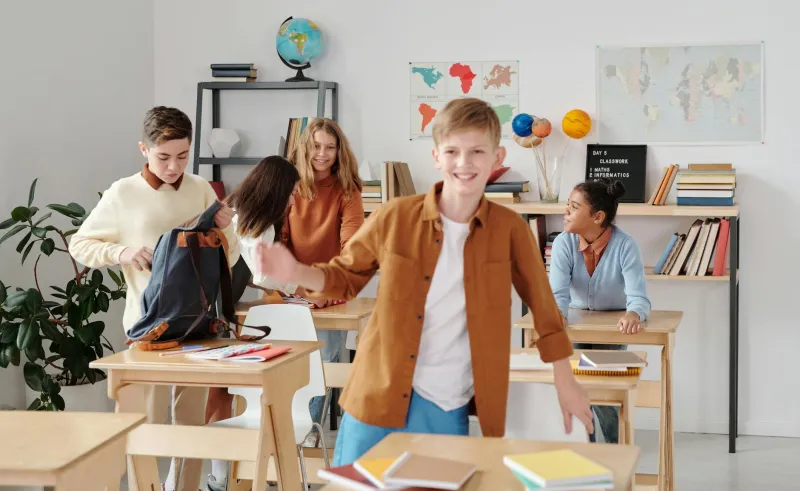
Walking into your new classroom on the first day used to be like opening a present. Everything was a surprise: the teacher's appearance, the way they decorated their room, where your assigned seat would be, who else would be sharing this space with you for the next nine months.
You'd spend those first few minutes taking in every detail. Was there a reading corner with bean bags? Did the teacher have interesting posters on the walls? Were there class pets? Each discovery added to your understanding of what kind of year you were about to have.
The teacher was equally mysterious. You might have heard rumors from older kids — "Mr. Peterson is really nice but he gives a lot of homework" — but their personality, teaching style, and expectations were all unknowns you'd discover gradually over the first few weeks.
When Technology Meant Overhead Projectors
The most sophisticated technology in most classrooms was an overhead projector, and even that felt pretty futuristic when the teacher rolled it out for a special presentation. Computer class, if your school had one, meant learning to type on actual typewriters or maybe early computers that could run simple programs.
The absence of constant connectivity meant that school existed in its own bubble. When you were in class, you were fully in class. There were no notifications, no online portals to check, no digital assignments that followed you home. Learning happened in real-time, in person, with immediate feedback and human interaction.
Projects meant trips to the library for research, not Google searches. Presentations meant poster board and markers, not PowerPoint slides. Collaboration happened face-to-face during designated group work time, not through shared documents and video calls.
The Modern September Preparation Machine
Today's first day of school arrives after weeks of preparation that would have seemed incomprehensible to previous generations. Parents receive orientation packets in July, complete with teacher bios, classroom photos, and detailed schedules. Kids attend virtual meet-and-greets where they can ask questions about bathroom policies and homework expectations.
By the time September arrives, students already know their teacher's educational philosophy, classroom management style, and probably their dog's name from social media posts. The mystery has been replaced by transparency, and while there are certainly benefits to this approach, something ineffable has been lost.
Technology has turned the first day of school into an IT setup session. Kids spend significant time learning login procedures for various educational platforms, troubleshooting device connections, and navigating digital interfaces. The focus has shifted from human connections to technical connections.
The Lost Art of Gradual Discovery
What made the old model special wasn't just the surprise — it was the gradual unfolding of relationships and understanding. You learned about your teacher's personality through daily interactions, not through a welcome video. You discovered your classmates' interests through playground conversations, not through digital profiles.
This slower revelation created deeper connections. When you finally figured out that your seemingly strict teacher actually had a great sense of humor, it felt like a personal discovery. When you realized your shy classmate was actually brilliant at math, it was a moment of genuine connection.
The anticipation itself was educational. Learning to sit with uncertainty, to be excited about the unknown, to approach new situations with curiosity rather than anxiety — these were valuable life skills that came naturally when September held genuine surprises.
Rediscovering September Magic
There's something to be said for transparency and preparation, especially for anxious children who benefit from knowing what to expect. But perhaps we've swung too far toward eliminating all mystery from what should be one of childhood's most magical transitions.
The first day of school used to teach kids that new experiences could be wonderful, that uncertainty could be exciting, and that the unknown held possibilities rather than threats. In our rush to make everything predictable and optimized, we may have inadvertently taught them that mystery is something to be eliminated rather than embraced.
Maybe the real lesson isn't about going back to complete unknowns, but about preserving some space for wonder in an increasingly transparent world. After all, the best parts of life still arrive unannounced, and learning to greet them with curiosity and excitement remains one of education's most important lessons.