When Learning Something New Meant Getting Your Shoes On
When Learning Something New Meant Getting Your Shoes On
Picture this: You're curious about how to fix a leaky faucet, wondering about the history of jazz music, or trying to settle a dinner table debate about which state has the most lakes. Today, you'd reach for your phone and have an answer in seconds. But just thirty years ago, that same curiosity would have sent you on an actual adventure.
The Geography of Knowledge
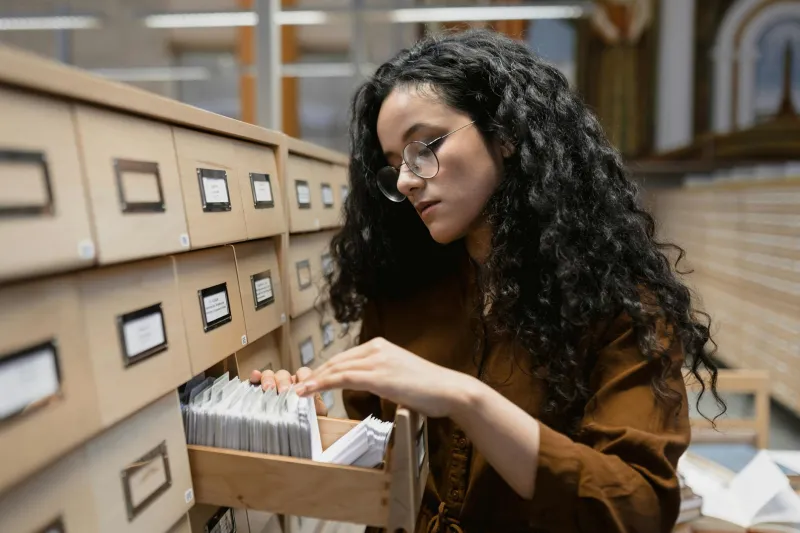
In 1985, knowledge lived in specific places. If you wanted to learn something new, you had to go somewhere to get it. The local library was your Google, complete with card catalogs that required their own learning curve. Bookstores were treasure hunts where you'd discover things you didn't even know you wanted to know. Adult education classes at community colleges filled up with people hungry to understand everything from car repair to conversational Spanish.
Americans in the pre-internet era became experts at navigating these knowledge ecosystems. They knew which librarian specialized in local history, which bookstore ordered the best technical manuals, and which community college professor made calculus actually make sense. Learning wasn't just about absorbing information — it was about building relationships with the people and places that housed knowledge.
The Ritual of Research
Research back then was a physical, time-consuming process that would seem almost comically inefficient today. Want to write a paper about the Civil War? You'd spend hours pulling books from shelves, photocopying relevant pages (at ten cents each), and taking handwritten notes on index cards. The Dewey Decimal System wasn't just a filing method — it was a roadmap to intellectual discovery.
But here's what's fascinating: this cumbersome process created something we've largely lost. When finding information required genuine effort, people engaged with it differently. You didn't just skim the first search result — you committed. You read entire chapters, not just headlines. You followed tangential threads because you were already invested in the hunt.
When Expertise Had Addresses
Before YouTube tutorials, if you wanted to learn a practical skill, you had to find an actual person to teach you. This meant joining clubs, taking classes, or convincing a neighbor to show you the ropes. Want to learn photography? You'd find the local camera club that met every Thursday at the community center. Curious about woodworking? You'd sign up for shop class at the high school's evening program.
These learning communities created something beyond just knowledge transfer — they built social connections around shared interests. The guy who taught you to change your oil might become your bowling partner. The woman who showed you how to knit might end up being your daughter's babysitter. Learning was inherently social because it had to be.
The Authority of Institutions
In the pre-internet world, information came with built-in credibility filters. Libraries curated their collections. Publishers had editorial standards. Universities had admissions requirements. If something made it into print and onto a shelf, it had passed through multiple layers of vetting.
This created a different relationship with authority and expertise. When the encyclopedia said something, people generally believed it — partly because challenging it would require another trip to the library to find contradicting sources. Misinformation existed, but it couldn't spread at light speed through social media algorithms.
The Patience Economy
Perhaps most remarkably, Americans in the 1970s and 80s accepted that learning took time — not just the time to absorb information, but the time to access it in the first place. If you were curious about something Tuesday evening, you might not get your answer until Saturday when the library reopened. This built-in delay created space for curiosity to marinate, for questions to develop complexity.
People would carry questions around for days or weeks, adding layers of interest and context before finally pursuing answers. By the time they made it to the library or bookstore, their curiosity had deepened into genuine investment.
What We Gained and Lost
Today's instant access to information has democratized learning in unprecedented ways. You can learn quantum physics from a Nobel laureate's lecture on YouTube or master French cooking from a chef in Lyon. Geographic and economic barriers to knowledge have largely collapsed.
But something subtle has shifted in how we relate to information itself. When answers come instantly, questions become disposable. When every fact is immediately verifiable, we've lost the art of productive uncertainty — that space between question and answer where deeper thinking happens.
The Deeper Engagement
The Americans who learned in the pre-digital era developed different intellectual habits. They became comfortable with not knowing things immediately. They learned to formulate better questions because they knew they'd have limited time with their sources. They developed patience with complexity because quick summaries weren't always available.
Most importantly, they understood that learning was a journey, not a destination — partly because the journey was literal, requiring them to leave their house, interact with other people, and invest real time and effort in the pursuit of knowledge.
Today's world has given us unprecedented access to information, but it's worth asking: In making learning effortless, have we accidentally made it less meaningful? The answer might be sitting on a shelf in your local library, waiting for someone curious enough to go find it.