When Getting to School Was Your First Taste of Freedom — Not a Security Risk
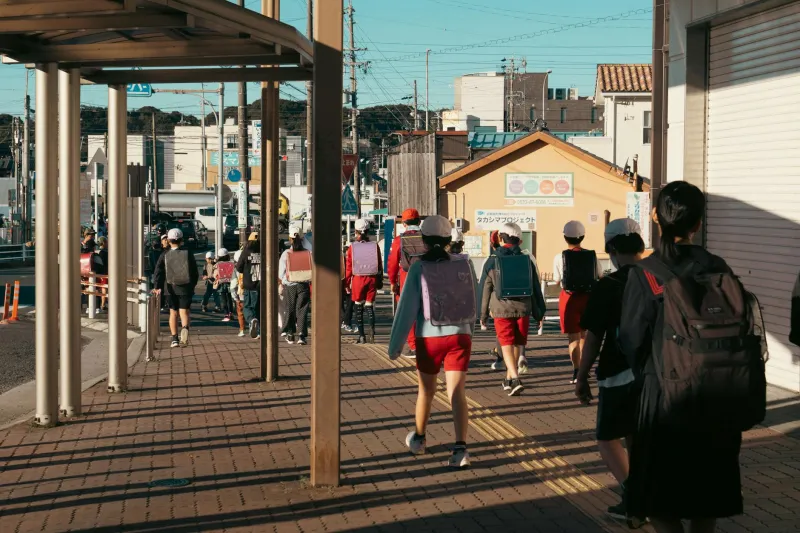
Picture this: It's 1985, and seven-year-old Sarah grabs her Trapper Keeper, kisses her mom goodbye, and heads out the front door alone. She'll walk six blocks to Lincoln Elementary, stopping to pick up her neighbor Tommy, racing leaves down storm drains, and arriving at school with grass stains on her knees and stories to tell. No GPS tracker. No cell phone. No parent escort required.
Fast-forward to today, and that same journey would send most parents into a panic spiral that ends with a call to Child Protective Services.
The Great American Walk to School
For decades, walking to school was as fundamental to childhood as losing teeth or learning to ride a bike. In 1969, nearly half of all students walked or biked to school. It wasn't considered brave or risky — it was Tuesday morning.
Kids as young as five would navigate their neighborhoods like tiny explorers, learning street names, recognizing friendly faces, and developing what psychologists now call "spatial awareness" and "environmental confidence." They'd meet up with friends at designated corners, forming impromptu walking groups that shifted and evolved throughout the school year.
The ritual started early. Parents would walk with kindergarteners for the first few days, pointing out landmarks: "Turn left at Mrs. Johnson's rose garden, cross at the stop sign, watch for the big oak tree." By October, most kids were flying solo, their small backpacks bouncing as they hurried to beat the first bell.
When Neighborhoods Had Eyes
This system worked because communities operated differently. Neighbors knew each other's children, and keeping an eye out was part of the social contract. Mrs. Peterson would wave from her kitchen window. Mr. Garcia would pause his lawn mowing to make sure the Henderson twins made it safely across Maple Street.
Crossing guards weren't uniformed professionals — they were often parent volunteers who'd rotate the duty weekly. The job required little more than a bright vest and the ability to hold up a stop sign with authority.
Schools reinforced this independence. There were no elaborate check-in procedures, no visitor badges, no locked doors during school hours. Kids arrived when they arrived, hung their coats on hooks, and got on with learning.
The Shift to Supervised Transit
Today, only 13% of students walk or bike to school. What happened to the other 87%?
The change didn't happen overnight. It was a gradual transformation driven by shifting perceptions of safety, changes in neighborhood design, and evolving ideas about what constitutes responsible parenting.
High-profile child abduction cases in the 1980s and 1990s — though statistically rare — created a climate of fear that fundamentally altered how parents viewed unsupervised time. The concept of "stranger danger" evolved from a helpful safety tip into a pervasive anxiety that made letting kids walk alone feel like negligent parenting.
The Carpool Revolution
Enter the modern school drop-off line: a carefully choreographed ballet of SUVs, minivans, and the occasional luxury sedan. What once took kids 15 minutes of walking now requires 45 minutes of driving, waiting, and maneuvering through traffic cones.
Parents arrive with travel mugs of coffee, backup snacks, and detailed pickup instructions written on index cards. School staff members armed with walkie-talkies direct traffic like air traffic controllers, ensuring each child is safely delivered to the correct adult.
The drop-off zone has its own etiquette: no cutting in line, engines must remain running, goodbyes should be quick and efficient. Some schools have implemented numbered placards and apps that notify parents when it's their turn to pull forward.
The Unintended Consequences
This shift toward supervised transportation has created ripple effects nobody anticipated. Kids who once arrived at school energized from their morning walk now spend their commute strapped into car seats, often arriving stressed from traffic delays or parental rushing.
The independence that came from navigating neighborhood streets has been replaced by the passive experience of being driven door-to-door. Children who once knew every crack in the sidewalk between home and school now couldn't give directions to their own classroom if dropped off at the wrong entrance.
Physically, the change is measurable. The Centers for Disease Control notes that the decline in walking to school has contributed to decreased daily physical activity among children. What was once built-in exercise — often the only exercise some kids got — has been eliminated from their routine.
When Safety Became Surveillance
Modern schools operate more like secure facilities than the open community spaces they once were. Visitors must be buzzed in, background-checked, and escorted. Students can't leave campus for lunch or even step outside without permission.
The walking school bus — where an adult supervises a group of neighborhood kids walking together — represents a compromise between old freedoms and new fears. But even these require liability waivers, volunteer training, and route approval from school administrators.
The Price of Protection
This transformation reflects broader changes in American society: the decline of tight-knit neighborhoods, the rise of dual-career families, and suburban design that prioritizes cars over pedestrians. Many modern subdivisions lack sidewalks entirely, making walking to school physically impossible.
Yet something valuable was lost in this transition. The confidence that came from successfully navigating the journey to school, the friendships formed during those daily walks, the sense of belonging to a neighborhood community — these were unintended casualties of our increased focus on safety.
Today's parents often express nostalgia for their own walking-to-school experiences while simultaneously feeling unable to provide the same freedom for their children. It's a generational shift that reflects not just changing attitudes about risk, but fundamental changes in how we structure childhood itself.
The first day of school used to mark a child's initial step toward independence. Now it marks their entry into a system designed to keep them safe — but perhaps at the cost of the very autonomy that walking to school was meant to teach.