The Family Vacation Was Already Exhausting Before You Even Left the Driveway
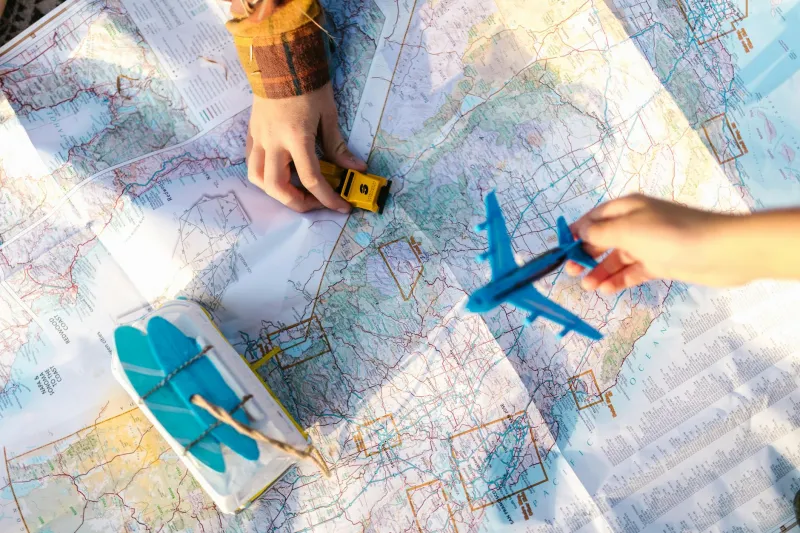
The Family Vacation Was Already Exhausting Before You Even Left the Driveway
Think about the last time you booked a trip. Maybe you spent twenty minutes on your phone — flipped through a few Expedia listings, checked some Google reviews, compared prices across a couple of apps, and hit confirm. Done. The hotel is booked, the flight is locked in, and your itinerary is sitting in your inbox.
Now imagine doing that same thing in 1965. No internet. No 800 numbers. No review sites. No GPS. Just you, a phone book, a paper map, and a lot of patience.
Planning a family vacation in mid-century America was a project in itself — a weeks-long undertaking that required real research, real coordination, and a genuine tolerance for uncertainty. And most families did it every summer without thinking twice, because it was simply how things worked.
The AAA TripTik Was the Google Maps of Its Day
For millions of American families, the planning process started with a trip to the local AAA office. The American Automobile Association offered a service called the TripTik — a custom-made, spiral-bound booklet of strip maps that charted your route, turn by turn, from your front door to your destination.
You'd sit down with a AAA travel counselor, tell them where you were headed, and they'd hand-assemble your personalized route guide. Each page covered a small segment of the journey, marked with recommended stops, gas stations, motels, and points of interest. It was genuinely useful — and getting one required a physical visit, an actual conversation, and usually a few days' wait while it was prepared.
The TripTik was remarkable for its time. It was also, by modern standards, hilariously limited. It couldn't tell you about traffic. It couldn't reroute around a detour. And if construction closed your planned road somewhere in rural Ohio, you were on your own.
The Travel Agent Was Not Optional
If your vacation involved a flight — still a significant expense in the 1960s, when air travel was far less democratized than it is today — you almost certainly used a travel agent. There was no other realistic option.
Flight schedules, fares, and availability were not public information in any accessible sense. Airlines published printed timetables, but actually booking a seat meant calling or visiting an agent who had access to reservation systems that ordinary consumers couldn't touch. The agent would look up options, quote you prices, and physically issue paper tickets that you'd need to keep safe and present at the airport.
This wasn't a luxury service. It was the infrastructure. Travel agents were as essential to booking a flight as a mechanic was to keeping your car running — you couldn't really do it yourself, so you found someone who could.
The Hotel Situation Was a Gamble
Finding a place to stay was its own adventure. For road trips, many families relied on a combination of AAA-approved motel guides, word-of-mouth recommendations, and — especially for shorter legs of a journey — simply pulling off the highway and hoping for the best.
The rise of roadside motel chains like Holiday Inn, Howard Johnson's, and Ramada in the 1950s and 60s was partly a response to exactly this uncertainty. Families trusted these brands because consistency was genuinely valuable when you had no other way to know what you were getting. A Holiday Inn in Georgia was supposed to feel like a Holiday Inn in Michigan — and that predictability was a selling point, not a cliché.
For those who planned further ahead, booking by mail was common. You'd write a letter to a hotel, ask about availability and rates, and wait for a written reply. The whole exchange could take two to three weeks. If you were lucky, a confirmation letter arrived before your departure date. If you weren't, you showed up and hoped.
There were no reviews to read. No star ratings. No photos beyond what appeared in a printed brochure, which was — to put it generously — not always an accurate representation.
The Research Phase Looked Nothing Like Today
Deciding where to go in the first place was a process that involved physical media in a way that's hard to fully appreciate now. Families consulted travel books — the Mobil Travel Guide was a popular annual publication — as well as state tourism brochures that you'd request by mail after seeing an ad in a magazine. Some households kept files of clippings from newspapers and magazines, destinations and hotels they'd read about and wanted to remember.
Libraries played a role too. If you were planning a trip to a national park, you might check out books about the region, study maps, and read up on what to expect — not because you were a particularly intense planner, but because there was no faster alternative.
The entire pre-trip research process that now takes under an hour could easily consume several weekends of effort.
Something Was Lost, But Something Was Also Gained
It's tempting to romanticize the old way — the anticipation, the physical maps spread across kitchen tables, the sense of genuine adventure in not quite knowing what you'd find. And there's something real in that. Uncertainty has a texture that convenience tends to sand away.
But let's be honest: the old system was also exhausting, exclusionary, and prone to failure in ways that fell hardest on people without time, access, or resources. Travel agents charged fees. AAA required a membership. Families without a car, a credit card, or a nearby travel office faced real obstacles that weren't romantic at all.
The frictionless travel planning of today didn't just make things easier — it opened the whole process up. Anyone with a smartphone can now do in minutes what once required connections, patience, and significant advance planning.
The vacation itself is still the point. But the world that existed before you could book it from your couch was a genuinely different place — and it's worth understanding just how much invisible work used to stand between an American family and a week away.